

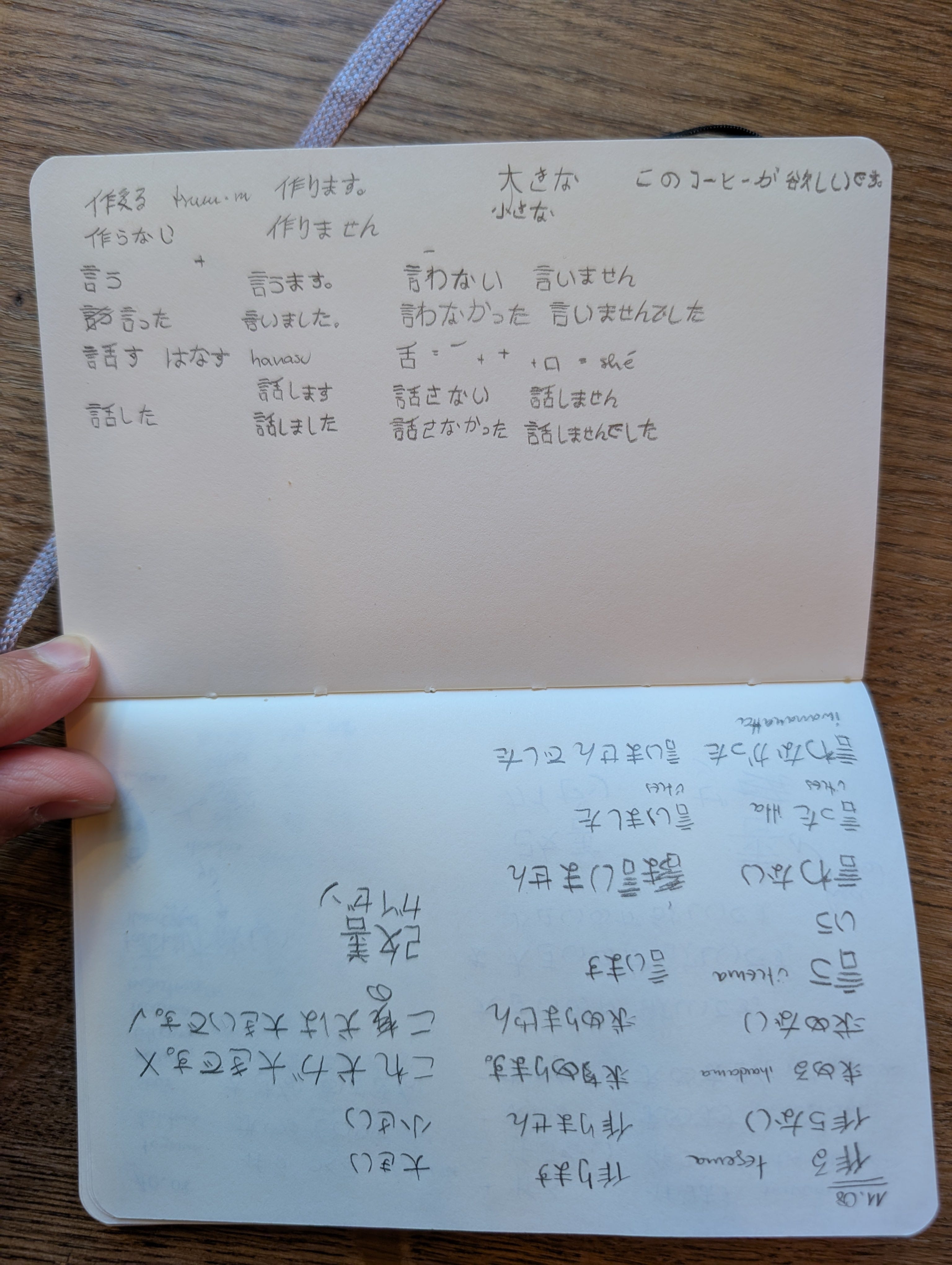
For the longest time I had this gut feeling that maybe Japanese isn't that hard after all.
The more I'm learning, the more I think it's true.
At least compared to other “hard” languages like Finnish, Estonian, or Hungarian.
People call them hard because they are unfamiliar.
And if your point of reference is “I know English, let me learn Spanish now” then that's true: you only need to learn the differences between the two systems and two vocabularies, and there aren't that many.
This doesn't say anything about the quality of the systems themselves.
Are they internally consistent? How many exceptions are there? What do need to memorize, what can you derive on the spot?
It's the systems where the above-mentioned languages shine.
Yes of course, actual use is different from the platonic ideal of the language, but easily derived once the platonic ideal form is known.
Japanese: Systems in Systems
Knowing English and encountering Spanish, you need to wrap your head around two systems: gender and conjugation.
You need to understand why it is la mesa, but el agua.
And why “do” changes across “I do”, “you do”, “we do” whereas in English it doesn't.
Japanese just takes the number of systems to the extreme:
two systems for writing sounds, according to the strict rules of sounds composition (the hiragana and katakana),
one system for writing meaning (the kanji), composing characters from about 200 basic building blocks,
the conjugation system: legos for adding meaning to verbs,
the politness systems,
and likely may more I don’t know about yet.
The nice part is that understanding these systems makes it really easy to make progress and not be lost. I’m just at the beginning of this, but today it really clicked.
Here, let’s walk through an example:
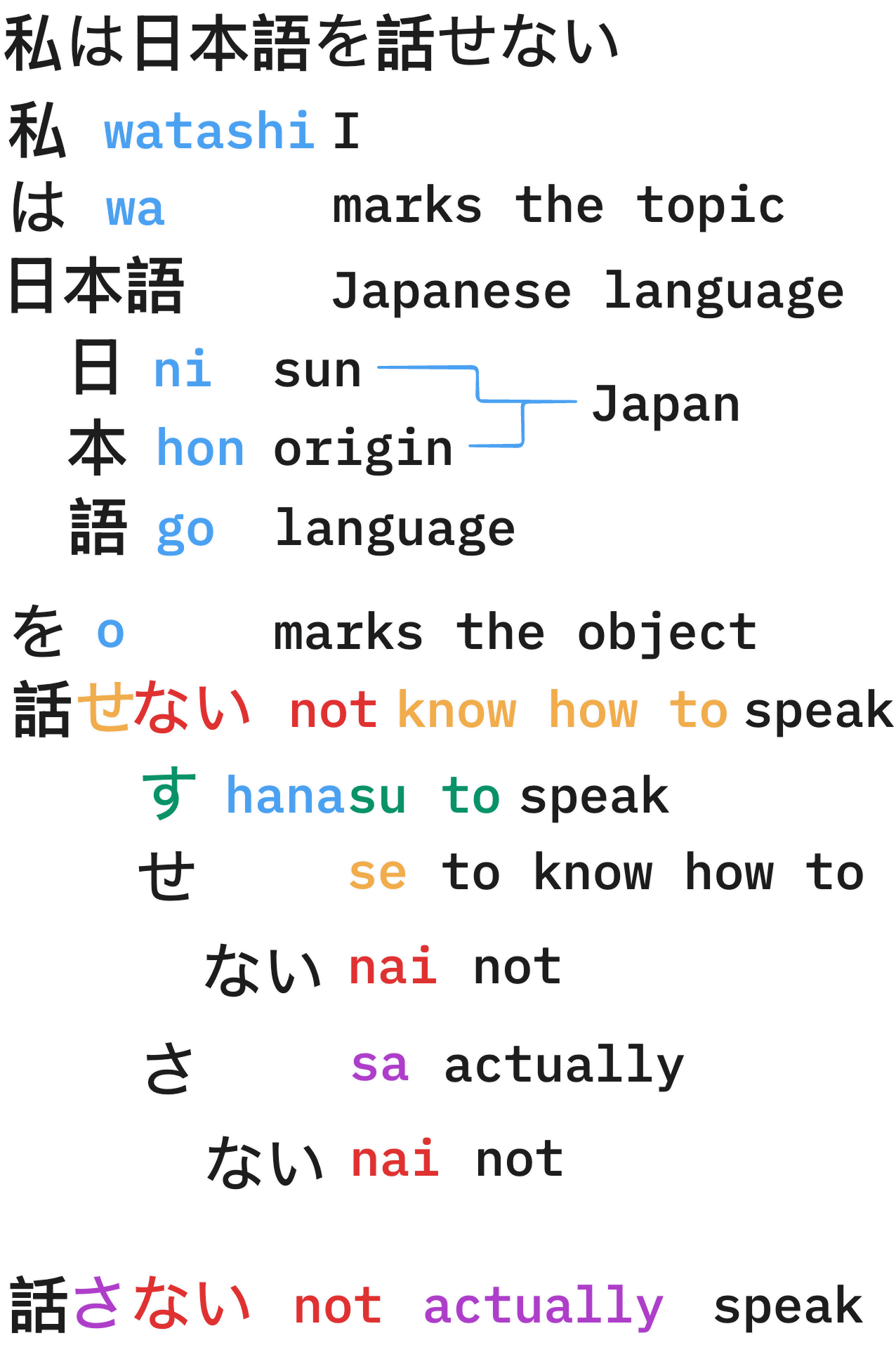
私は日本語を話せない。I don’t [know how to] speak Japanese
This translates literally into something like:
私は - watashi wa - “it is I, who”
日本 - nihon - “Japan”
語 - go - “language”
を - o [marks the target of the action]
話せない - hana·se·nai - “speak·know·not”
So here we have a bunch of Kanji: 私, 日, 本, 語, 話 and if you look closely, you can see that some parts repeat: 口 is the sign for mouth and it shows up in the character for language (語), and for speak (話). Multiple times in fact, because the left part of both is again a shared building block: 言 gonben meaning “speech” and showing up in characters with language-related meaning.
And notice that the 口 mouth character shows up again in the character for speech.
What clicked today:
na is a reusable building block in verbs to negate the meaning,
i is added then na appears at the end,
likewise for the polite way to say it, masen plays the same role,
[t]ta is the indicator for the past
Knowing this, you can start peeling off layers of meaning by reading word forms right to left, which again accelerates learning.